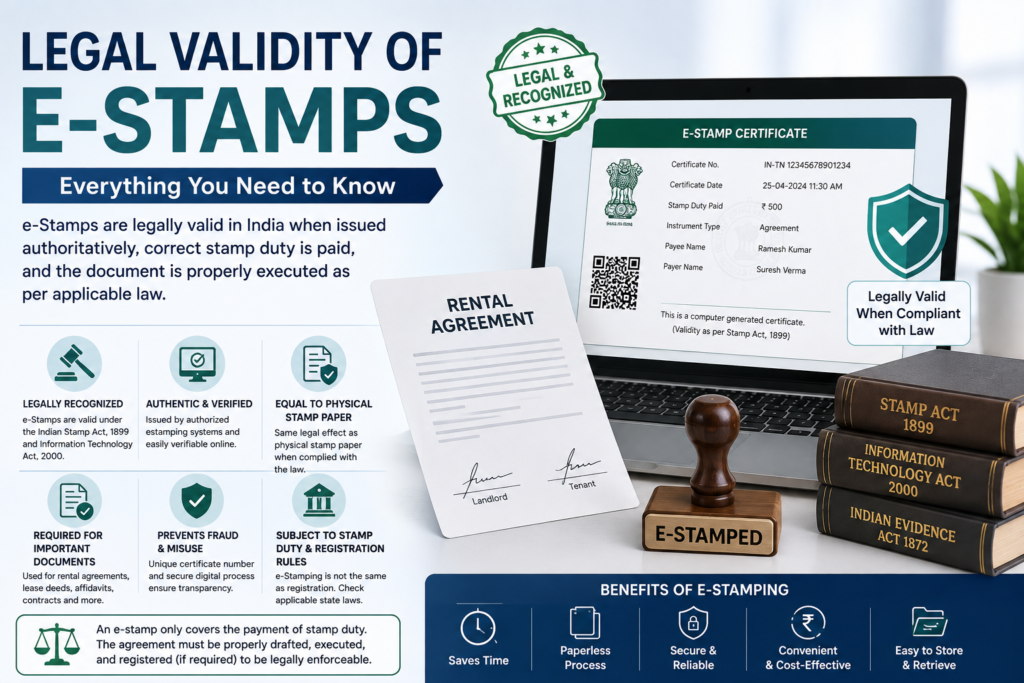
Legal Validity of e-Stamp Papers in India: Everything You Need to Know
With the growing popularity of online documentation, e-Stamping has become a convenient alternative to traditional physical stamp paper. From rental agreements and lease agreements to affidavits and business contracts, e-stamps are increasingly used to pay applicable stamp duty and document transactions.
But a common question remains: Are e-stamp papers legally valid in India?
The short answer is yes, an e-stamp certificate can be legally valid when it is issued through an authorized process, the correct stamp duty is paid, and the underlying document is properly executed and complies with applicable law.
However, an e-stamp by itself does not automatically make every document legally enforceable. The nature of the document, applicable state stamp law, execution, registration requirements, and other legal conditions also matter.
What Is an e-Stamp?
An e-stamp certificate is an electronic form of stamp duty payment used for instruments that are subject to stamp duty.
Instead of purchasing traditional physical stamp paper, the required stamp duty can be paid through an authorized electronic stamping system, where available.
The certificate generally contains details such as:
- Certificate or identification number
- Date of issue
- Stamp duty amount
- Details of the parties or transaction
- Document or instrument information
- Other relevant transaction details
The exact format and process can vary between states.
Are e-Stamps Legally Valid in India?
Yes. e-stamping can have legal validity, provided the applicable legal and procedural requirements are followed.
The important distinction is that an e-stamp primarily deals with payment of stamp duty. The legal enforceability of the underlying agreement depends on more than simply having an e-stamp certificate.
Under the Indian Stamp Act, 1899, instruments that are chargeable with stamp duty are subject to the applicable stamping requirements. Section 17 provides that instruments chargeable with duty and executed in India are to be stamped before or at the time of execution, subject to applicable provisions and state amendments.
For electronic documents and signatures, the Information Technology Act, 2000 provides legal recognition to electronic records and electronic signatures, subject to its provisions. Sections 4 and 5 recognize electronic records and electronic signatures in circumstances covered by the Act.
Therefore, an electronically created or signed document should not be treated as invalid merely because it exists in electronic form.
e-Stamp vs Physical Stamp Paper
Both methods can serve the purpose of paying applicable stamp duty, but the process is different.
| e-Stamp | Physical Stamp Paper |
|---|---|
| Electronic certificate | Physical paper |
| Generated through an authorized system | Purchased through an authorized vendor/channel |
| Easier to maintain digitally | Requires physical safekeeping |
| Certificate details can be verified where applicable | Physical document is retained |
| Convenient for online documentation | Traditional documentation method |
The availability and procedure for e-stamping depend on the relevant state and applicable rules.
Does an e-Stamp Make an Agreement Legally Valid?
Not by itself.
An e-stamp generally addresses the stamp duty requirement. The underlying agreement must still satisfy the requirements applicable to that type of contract.
For example, a rental agreement may need:
- Correct landlord and tenant details
- Accurate property details
- Clearly defined rent
- Security deposit terms
- Tenure
- Notice period
- Termination conditions
- Proper execution
- Applicable stamp duty
- Registration, where required
Simply attaching an e-stamp certificate to an improperly drafted or improperly executed agreement does not automatically cure those issues.
Is an e-Stamped Rental Agreement Valid?
An appropriately stamped rental agreement can be legally valid when it is properly drafted and executed and complies with the applicable state requirements.
For a rental agreement, it is important to distinguish between:
Stamping — payment of the applicable stamp duty.
Execution — signing or otherwise properly executing the agreement.
Registration — registration of the document where the law requires it.
These are separate legal concepts.
What Makes an e-Stamp Legally Reliable?
When obtaining an e-stamp, consider the following:
1. Authorized Issuance
Use an authorized e-stamping channel applicable to the relevant state.
2. Correct Stamp Duty
The appropriate amount of stamp duty should be paid based on the nature of the instrument and applicable law.
3. Accurate Details
Names, addresses, property details, document type, and other information should be entered correctly.
4. Proper Execution
The underlying agreement should be properly signed or electronically authenticated as applicable.
5. Verification
Where a verification facility is available, verify the e-stamp certificate details.
6. Registration Where Required
If the applicable law requires registration, e-stamping alone is not a substitute for registration.
Can an e-Stamp Be Used as Evidence in Court?
The legal treatment of an e-stamp and the underlying electronic document depends on the facts and applicable law.
Indian law recognizes electronic records in appropriate circumstances. The current evidence framework also provides that an electronic or digital record is not to be denied admissibility merely because it is electronic, subject to the applicable evidentiary requirements.
However, whether a particular agreement is enforceable or admissible in a specific dispute can depend on issues such as:
- Proper execution
- Authenticity
- Integrity of the document
- Stamp duty
- Registration requirements
- Evidence requirements
- Applicable state law
Therefore, an e-stamp should be treated as one part of a properly completed documentation process.
How to Verify an e-Stamp Certificate
Before using an e-stamp for an important agreement, check whether the issuing authority or authorized system provides a certificate verification facility.
Review details such as:
- Certificate number
- Issue date
- Stamp duty amount
- Party names
- Document details
- Transaction information
If any information is incorrect, it should be addressed promptly through the appropriate channel.
What Happens If the Correct Stamp Duty Is Not Paid?
Failure to properly stamp an instrument can create legal and procedural problems.
The Indian Stamp Act contains provisions dealing with instruments that are not duly stamped, including provisions concerning examination and impounding.
The consequences can depend on the applicable state law and the nature of the document.
This is why it is important to determine the correct stamp duty before executing the agreement, rather than treating stamping as an optional step.
Benefits of Using e-Stamping
Faster Documentation
e-stamping can make the stamp-duty payment process more convenient than traditional paper-based methods.
Reduced Paperwork
The certificate can be maintained along with the electronic documentation.
Easier Record Keeping
Digital records are easier to store and retrieve when properly maintained.
Convenient for Online Agreements
It works well with online rental agreement services and other digital documentation workflows.
Better Tracking
Certificate details can provide a useful reference for the stamp-duty transaction.
Common Mistakes to Avoid
❌ Choosing the Wrong Document Type
Stamp duty depends on the nature of the instrument. Make sure the correct document category is selected.
❌ Paying Incorrect Stamp Duty
The amount should be determined according to the applicable law and transaction details.
❌ Entering Incorrect Party Details
Check names and other details carefully before finalizing the certificate.
❌ Assuming e-Stamp Means Registration
Remember that e-stamping and registration are different processes.
❌ Using Unverified Sources
Obtain e-stamps through an authorized and reliable process.
❌ Ignoring State-Specific Rules
Stamping requirements can differ between states. Always check the rules applicable to the location and document.
e-Stamping for Rental Agreements
For landlords and tenants, e-stamping can make the process of creating a rental agreement online more convenient.
A typical workflow may include:
Step 1: Enter landlord and tenant details
Step 2: Add property information
Step 3: Enter rent and security deposit
Step 4: Select the appropriate agreement terms
Step 5: Determine applicable stamp duty
Step 6: Complete e-stamping through the applicable process
Step 7: Execute the agreement
Step 8: Complete registration if required
The exact process may vary depending on the state and service provider.
Why Choose AgreementKart for e-Stamping?
AgreementKart helps simplify the process of preparing rental agreements and e-stamping online.
Instead of dealing with complicated paperwork, landlords and tenants can provide their details, prepare the agreement, and complete the applicable documentation process through one platform.
Frequently Asked Questions
Is an e-stamp legally valid in India?
Yes. An e-stamp can be legally valid when issued through an authorized process and used in compliance with applicable stamp laws and other legal requirements.
Is an e-stamp the same as a digital signature?
No. An e-stamp primarily relates to payment of stamp duty. A digital or electronic signature is a method of authenticating an electronic document.
Is an e-stamped rental agreement legally valid?
It can be, provided the rental agreement is properly drafted, appropriately stamped, properly executed, and complies with applicable registration and other legal requirements.
Can I use an e-stamp for a rental agreement?
Yes, where e-stamping is available and permitted for the relevant instrument under the applicable state system.
Does e-stamping replace registration?
No. Stamping and registration are separate requirements. Whether registration is required depends on the document and applicable law.
Can I verify an e-stamp?
Verification facilities may be available through the relevant authorized system. Always check the certificate details before relying on it.
Conclusion
e-stamps are an important part of modern digital documentation in India, providing a convenient way to pay applicable stamp duty for eligible instruments.
However, legal validity does not depend on the e-stamp alone. A legally sound agreement should also have the correct terms, appropriate stamp duty, proper execution, and registration where required.
For landlords and tenants, understanding the difference between e-stamping, signing, and registration is essential before finalizing a rental agreement.
If you want a convenient way to create a properly structured online rental agreement with e-stamping, AgreementKart can help simplify the process