
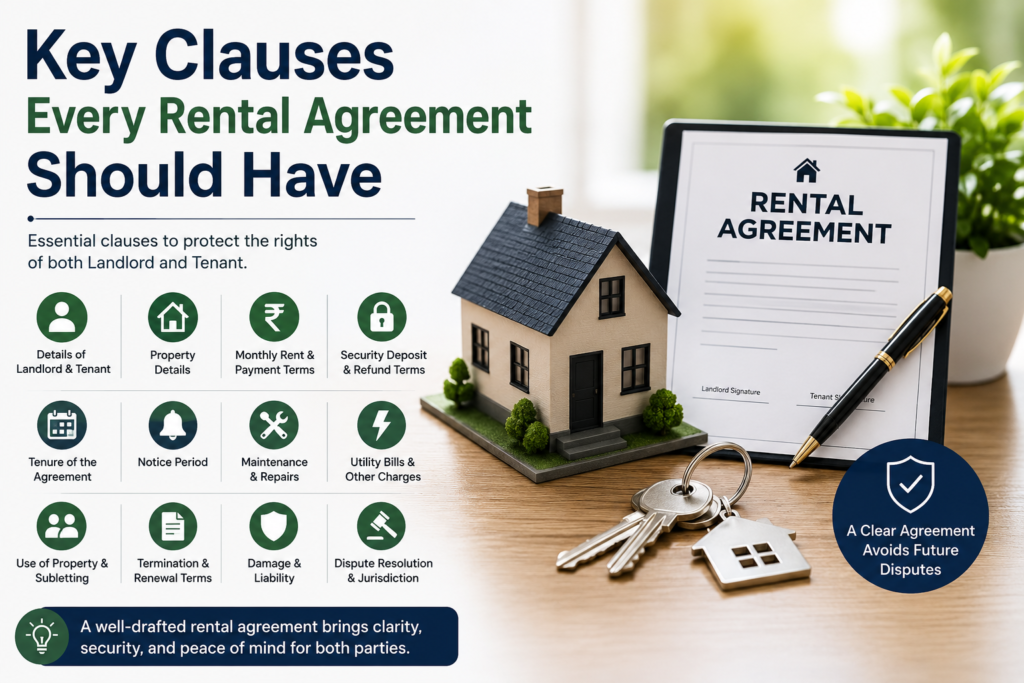
Key Clauses Every Rental Agreement Should Have
A rental agreement is more than a document stating the monthly rent. It is a legal agreement between a landlord and tenant that defines their rights, responsibilities, and obligations during the tenancy.Whether you are renting an apartment, independent house, villa, or commercial property, a properly drafted rental agreement can help prevent misunderstandings and disputes.From rent and security deposits to notice periods and maintenance responsibilities, every important term should be clearly mentioned before the agreement is signed.
n this guide, we explain the key clauses every rental agreement should have and why they matter.
1. Details of the Landlord and Tenant
The rental agreement should clearly identify all parties involved.
It should generally include:
- Full name of the landlord
- Full name of the tenant
- Permanent address
- Current address, where applicable
- Contact number
- Identification details, where appropriate
If there is more than one tenant, the agreement should clearly mention all tenants who will occupy the property.
Why is this important?
Correct identification helps establish who is legally entering into the rental arrangement and can reduce confusion if a dispute arises later.
2. Complete Property Details
The agreement should contain the complete address and description of the rented property.
This may include:
- Flat or house number
- Building or apartment name
- Floor number
- Street and locality
- City and PIN code
- Parking details, if applicable
- Other areas or facilities included with the property
For example, if a parking space, storage area, or specific appliances are included with the rental, they can be mentioned clearly in the agreement.
Why is this important?
A precise property description avoids disputes about what exactly has been rented to the tenant.
3. Monthly Rent Clause
The monthly rent should be clearly stated in both numbers and words wherever appropriate.
The clause should specify:
- Monthly rent
- Rent payment date
- Payment method
- Bank account details, if applicable
- Late payment terms, if agreed
For example:
The Tenant shall pay a monthly rent of ₹25,000 on or before the 5th day of each calendar month.
Why is this important?
A clear rent clause establishes exactly how much the tenant must pay and when the payment is due.
4. Security Deposit Clause
The security deposit is one of the most important terms in a rental agreement.
The agreement should specify:
- Amount of security deposit
- Date of payment
- Conditions for deductions
- When the deposit will be refunded
- Permitted deductions, if any
The agreement should clearly distinguish between security deposit and advance rent.
Why is this important?
Security deposit disputes are common when the agreement does not clearly explain when and how the deposit will be returned.
5. Rental Period or Tenure
The agreement should mention the exact:
- Start date
- End date
- Duration of tenancy
For example:
The tenancy shall commence on 1 September 2026 and shall remain valid until 31 July 2027, unless terminated earlier in accordance with the terms of this Agreement.
The agreement should also explain what happens when the initial rental period expires.
6. Rent Increase or Escalation Clause
If the landlord and tenant have agreed to increase the rent after a particular period, the terms should be clearly written.
The clause can specify:
- Percentage or amount of increase
- Date from which the increase applies
- Conditions for renewal
For example:
Upon renewal of the agreement, the monthly rent may be revised by mutual agreement between the Landlord and Tenant.
Avoid relying on verbal promises about future rent increases.
7. Notice Period Clause
The notice period explains how much advance notice the landlord or tenant must provide before ending the tenancy.
For example:
Either party may terminate the agreement by providing 30 days’ prior written notice to the other party.
The exact notice period should be mutually agreed and properly documented.
Why is this important?
A written notice clause provides clarity when either party wants to end the tenancy.
8. Lock-In Period Clause
Some rental agreements contain a lock-in period during which one or both parties agree not to terminate the agreement except under specified circumstances.
If a lock-in period applies, the agreement should mention:
- Duration of the lock-in period
- Who is bound by it
- Exceptions, if any
- Consequences of early termination
Example
The parties agree to a lock-in period of six months from the commencement date, subject to the exceptions specified in this Agreement.
A lock-in clause should be drafted carefully because its consequences can vary depending on the agreement and applicable law.
9. Maintenance and Repair Clause
The agreement should clearly establish who is responsible for maintenance and repairs.
For example:
Tenant may typically be responsible for:
- Minor day-to-day maintenance
- Damage caused by the tenant or occupants
- Replacing consumables, where agreed
Landlord may typically be responsible for:
- Major structural repairs
- Major plumbing or electrical issues
- Repairs arising from normal wear and tear, subject to the agreement
The exact allocation should be clearly documented rather than assumed.
10. Utility Bills and Other Charges
The agreement should specify who will pay for:
- Electricity
- Water
- Gas
- Internet
- Maintenance charges
- Society or association charges
- Property-related services
For example:
Electricity and internet charges consumed by the Tenant shall be borne by the Tenant.
Clear allocation of expenses can prevent disagreements during the tenancy.
11. Use of the Property
The agreement should state how the property may be used.
For a residential rental, it can specify that the property is to be used for residential purposes only, unless otherwise agreed.
It may also address:
- Commercial use
- Illegal activities
- Subletting
- Paying guests
- Alterations to the property
Why is this important?
The landlord should know how the property will be used, while the tenant should understand what activities are permitted.
12. Subletting Clause
If the tenant is not allowed to sublet the property, this should be explicitly mentioned.
For example:
The Tenant shall not sublet, assign, or transfer possession of the premises to any third party without the prior written consent of the Landlord.
This helps protect the landlord from unauthorized occupants.
13. Occupants and Guests
The agreement can specify who is permitted to occupy the property.
Where relevant, it may include:
- Names of occupants
- Number of permitted occupants
- Guest rules
- Restrictions imposed by the housing society
This is particularly useful for apartments and gated communities where society rules may apply.
14. Pets Clause
If pets are allowed, restricted, or subject to specific conditions, the agreement should state the arrangement clearly.
For example:
The Tenant may keep a pet at the premises subject to applicable apartment association or society rules.
This avoids misunderstandings between landlords and tenants.
15. Alteration and Modification Clause
Tenants should generally not make major structural or permanent changes to a rented property without the landlord’s consent.
The agreement can specify whether the tenant may:
- Paint walls
- Install fixtures
- Drill into walls
- Modify electrical fittings
- Make structural changes
Any permitted modifications should ideally be agreed in writing.
16. Property Inspection Clause
The agreement may provide reasonable conditions under which the landlord can inspect the property.
For example:
The Landlord may inspect the premises with reasonable prior notice to the Tenant, except in emergencies or where otherwise permitted by applicable law.
This gives both parties clarity regarding property inspections and privacy.
17. Damage and Repairs Clause
The agreement should distinguish between:
Normal wear and tear
and
Damage caused by negligence, misuse, or intentional acts.
It should explain who bears the cost of repairs in each situation.
This can become particularly important when the security deposit is being refunded at the end of the tenancy.
18. Termination Clause
The termination clause explains when and how the agreement can come to an end.
It may cover circumstances such as:
- Expiry of the rental period
- Notice by either party
- Non-payment of rent
- Material breach of the agreement
- Unauthorized subletting
- Serious damage to the property
The termination provisions should be consistent with the rest of the agreement and applicable law.
19. Renewal Clause
If the landlord and tenant intend to continue the tenancy after the initial term, the agreement can explain the renewal process.
It can mention:
- Renewal period
- Revised rent
- Notice required for renewal
- Changes to the original terms
A renewal should ideally be documented rather than relying solely on an informal verbal arrangement.
20. Handover and Vacating Clause
The agreement should explain what the tenant must do when vacating the property.
It may cover:
- Returning keys
- Removing personal belongings
- Cleaning the premises
- Settling utility bills
- Returning appliances or furniture
- Property inspection
- Security deposit settlement
A clear handover process can make the end of the tenancy much smoother.
21. Inventory and Fixtures Clause
For furnished or semi-furnished properties, include a list of items provided with the property.
For example:
- Bed
- Sofa
- Dining table
- Wardrobe
- Refrigerator
- Washing machine
- Air conditioner
- Geyser
The condition of important items can also be recorded when the tenant takes possession.
22. Dispute Resolution Clause
A rental agreement should ideally explain how disputes will be addressed.
The parties may agree on an appropriate mechanism, subject to applicable law, such as negotiation, mediation, or other legally permitted dispute-resolution methods.
The agreement should also specify the applicable jurisdiction where appropriate.
23. Stamp Duty and Execution Clause
A rental agreement should be properly executed and appropriately stamped according to the applicable state law.
The applicable stamp duty and registration requirements can vary depending on factors such as:
- State
- Tenure
- Rent
- Security deposit
- Nature of the property
- Applicable legal provisions
24. Signature and Witness Clause
The agreement should be signed by the relevant parties.
It may include:
- Landlord’s signature
- Tenant’s signature
- Witness signatures, where required or advisable
- Date and place of execution
The names of the witnesses should also be clearly recorded where witnesses are used.
Additional Clauses for Special Situations
Depending on the property and arrangement, you may also consider clauses covering:
- Parking
- Furnished property
- Co-living arrangements
- Company-leased accommodation
- Commercial use
- Pet permissions
- Society rules
- Power backup
- Water supply
- Appliances
- Visitor restrictions
- Smoking restrictions
- Work-from-home arrangements
Not every rental agreement needs every possible clause. The agreement should reflect the actual arrangement between the landlord and tenant.
Common Mistakes to Avoid
Before signing a rental agreement, check for these common mistakes:
1. Incorrect names or addresses
Verify all personal and property details.
2. Unclear rent terms
Mention the exact rent and payment date.
3. No security deposit conditions
Clearly state when and how the deposit will be refunded.
4. Missing notice period
Specify how much notice is required for termination.
5. Verbal promises
Important terms should be included in the written agreement.
6. Ignoring stamp duty
Make sure the agreement is appropriately stamped as required by applicable law.
7. Not checking registration requirements
Depending on the tenure and applicable law, registration may be required.
8. Not reviewing the final document
Read the complete agreement before signing or executing it.
Rental Agreement Checklist
Before finalizing your rental agreement, make sure it includes:
☑ Landlord details
☑ Tenant details
☑ Complete property address
☑ Monthly rent
☑ Security deposit
☑ Agreement duration
☑ Rent payment date
☑ Notice period
☑ Lock-in period, if applicable
☑ Maintenance responsibilities
☑ Utility payments
☑ Property usage rules
☑ Subletting conditions
☑ Termination terms
☑ Renewal terms
☑ Handover conditions
☑ Stamp duty and execution requirements
☑ Signatures and witnesses, where applicable
Create Your Rental Agreement Online with AgreementKart
Creating a rental agreement doesn’t have to involve complicated paperwork or repeated visits to an office.
AgreementKart helps landlords and tenants create rental agreements online with a streamlined documentation process. You can provide the required details, review the agreement, and complete the applicable e-stamping and execution process based on the requirements for your location.
Whether you are renting a home in Hyderabad, Bangalore, Delhi, Noida, Chennai, Kolkata,Lucknow,Gurugram or other cities in India, having a properly prepared rental agreement can make the rental process more transparent and secure.
Conclusion
A well-drafted rental agreement clearly sets expectations for both landlords and tenants. Clauses covering rent, security deposit, duration, maintenance, notice period, termination, property use, and other important responsibilities can help reduce misunderstandings and future disputes.
Before signing, both parties should carefully review the agreement and ensure that the applicable stamp duty, execution, and registration requirements have been addressed.
If you’re looking for a convenient way to prepare a rental agreement online, AgreementKart can help simplify the documentation and e-stamping process.
Create your rental agreement online with Agreement Kart and make your rental documentation simple, clear, and convenient